

A Simple Content System for Service Businesses That Want Leads, Not Hobbies
Social Media Management fails for most service businesses for one boring reason: you treat posting like a task, not a system. One post a week feels responsible. It usually produces random reach, no momentum, and a constant scramble for ideas.
People spend a lot of time on social, but they do not spend it waiting for your weekly update. DataReportal reports that the typical internet user spends about 2 hours and 21 minutes per day on social media. You win by showing up consistently with the right messages, not by posting once and hoping.

Social Media Management | Content Creation
Quick Answer
Stop trying to invent a new post every week. Pick five content buckets, create one core asset per week, repurpose it into multiple formats, and repeat the same offer and CTA language across every platform.
TL;DR
- One post a week is not a plan. It is a delay tactic.
- Use content buckets so you never start from zero.
- Repurpose one core asset into multiple posts.
- Keep your visuals and CTA language consistent.
- Stop doing the things that waste time and signal low trust.
Why “One Post a Week” Usually Fails
It fails because it creates a content gap. You post, then you disappear. Your buyers keep scrolling. Your competitors keep showing proof.
Benchmarks vary by industry, but the pattern is clear: brands post far more than once a week. Socialinsider’s 2026 benchmarks note that brands average about 5 posts per week on Instagram and TikTok, and engagement rates differ massively by platform.

This does not mean you should spam. It means you need a repeatable system that produces consistent output without stealing your life.

The Simple System: One Core Asset Becomes Five Posts
Your week starts with one core asset. That is your anchor. You then repurpose it into formats each platform actually favors.
| Core Asset | Repurpose Into | Goal |
| One short video or photo set | Short video, carousel, story set, proof post, FAQ post | Reach plus trust |
| One short written tip | Graphic quote, caption post, story poll, pinned FAQ | Clarity plus authority |
| One customer result | Before-and-after, testimonial card, and process breakdown | Proof that converts |
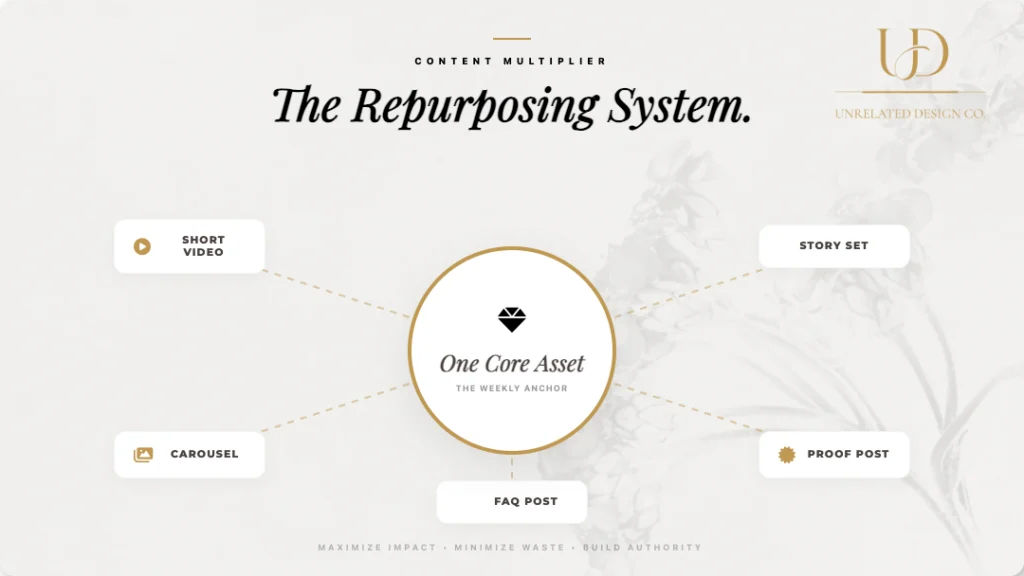
This is how most marketers operate in real life. HubSpot reports that 48 percent of social marketers share similar or repurposed content across platforms with minor adaptations, instead of building everything from scratch.

Content Buckets That Work for Service Businesses
If you sell a service, you do not need viral ideas. You need content that reduces risk and makes the next step obvious.
Bucket 1: Proof
- Before-and-after
- Results and outcomes
- Testimonials with context
Bucket 2: Process
- What happens after someone calls
- Your steps from quote to completion
- What makes your approach safer or faster
Bucket 3: Problems
- Common issues you fix
- How to spot a problem early
- What not to do
Bucket 4: People
- Your team and your values
- Behind-the-scenes
- Community and partnerships
Bucket 5: Promotions
- Seasonal offers
- Limited availability
- New services
Use these buckets to build a predictable rhythm. You stop guessing. Your audience starts recognizing you.

Brand Consistency: The Fastest Way to Look More Expensive
Consistency does not mean boring. It means your buyer can tell it is you in half a second.
Make these consistent everywhere:
- One offer line
- One primary CTA line
- One visual style for proof
- One voice and tone

Consistency is also a usability principle, not just a design preference. Nielsen Norman Group covers it under consistency and standards.
What to Stop Doing If You Want Your Time Back
- Chasing trends daily
- Posting without a clear next step
- Switching your offer every week
- Stock photos that look like everyone else
- Deleting posts because likes were low
- Rewriting everything from scratch for every platform
- Hashtag dumping with no intent
Most of that behavior signals uncertainty. Buyers read that as risk and move on.

A Weekly Workflow You Can Actually Follow
| Day | Task | Time |
| Monday | Create one core asset based on a bucket | 45 minutes |
| Tuesday | Repurpose into 2 formats | 30 minutes |
| Wednesday | Repurpose into 2 more formats | 30 minutes |
| Thursday | Engage and respond to comments and messages | 15 minutes |
| Friday | Post one proof item and one CTA | 15 minutes |
If you do this weekly, you are no longer “posting.” You are building a library of proof and clarity that compounds.
Questions People Ask Before They Hire You
If you want leads, answer these in your content. These questions are already in your buyer’s head. Your job is to remove doubt fast.
How Many Times per Week Should a Service Business Post?
Start with three to five posts per week, using repurposed content rather than fresh ideas every time. Benchmarks show brands average around 5 posts per week on Instagram and TikTok, which you can hit with a system rather than chaos. See the Socialinsider posting frequency benchmarks.
Does Repurposing Hurt Performance?
No, if you adapt the format. Repurposing saves time and keeps your message consistent. HubSpot reports 48 percent of marketers repurpose with minor adaptations, which is the realistic approach for small teams. Use the HubSpot repurposing stats as your sanity check.
What Should I Post If My Business Is Not “Exciting”?
Proof, process, problems, people, and promotions. Service businesses win with clarity and trust, not entertainment.
How Do I Stay Consistent When I Am Busy?
Use buckets and templates. Create one core asset weekly, then repurpose it. Keep one offer line and one CTA line for a full month.
What Should I Stop Doing Right Now?
Stop chasing trends daily, stop posting without a next step, and stop rebuilding content from scratch for each platform. Those habits waste time and produce random results.

If you are done wasting time on random posting, build a system that produces consistent proof and consistent leads. Get Social Media Management plus Content Creation and let your content finally pull its weight.